




Presented by

2026 Trends and Insights on the Administrative and Executive Assistant Profession

A data-backed study on salary, job satisfaction, AI, tools, and more

Real data from the world's most advanced calendar users at:
View highlights from the full 30-page report!

Demographics

This section reflects insights from 600 Executive Assistants who are part of the global CCing My EA and Vimcal EA communities. While not a full industry census, these results offer a detailed look into the future of the profession.

Roles & titles

Executive Assistant:
65.2%
Senior Executive Assistant:
22.2%
Chief of Staff:
2.5%
Administrative/Office Manager:
3.3%
Other:
6.8%

Years of experience

Less than 1 year

5.2%

1-3 years

16.5%

4-6 years

17.8%

7-10 years

16.3%

10+ years

44.2%

This sample skews experienced; nearly half report 10+ years in EA or similar roles.

Primary industries (multiple choice; totals >100%)

Technology
22.2%
Finance
14.7%
Non-profit
13.2%
Corporate and Large Enterprise
12.9%
Education
12%
Startup
10%
Small Medium Businesses
9.3%
Healthcare
8.5%
Retail and Consumer Goods
4.2%
Media and Entertainment
3.7%
Other
19%
These were open text answers so they’re likely under-reported:
Government
2.6%
Law
2.3%
Manufacturing
1.7%
Construction
1.2%
Insurance
0.8%
Consulting
0.8%
Real Estate
0.8%
Hospitality
0.7%
Biotech
0.7%
Energy
0.5%
Engineering
0.5%
Marketing
0.5%

Breakdown by country

1)
United States
77%
Tier 1 (NYC + Bay Area):
21.3%
Tier 2 (Other high-cost metros):
43.8%
Tier 3 (Other U.S. cities/towns):
34.8%
2)
Canada
7.7%
3)
United Kingdom
6.7%
4)
Australia
4.3%
5)
New Zealand
1.2%
6)
Netherlands
0.3%
7)
Poland
0.3%
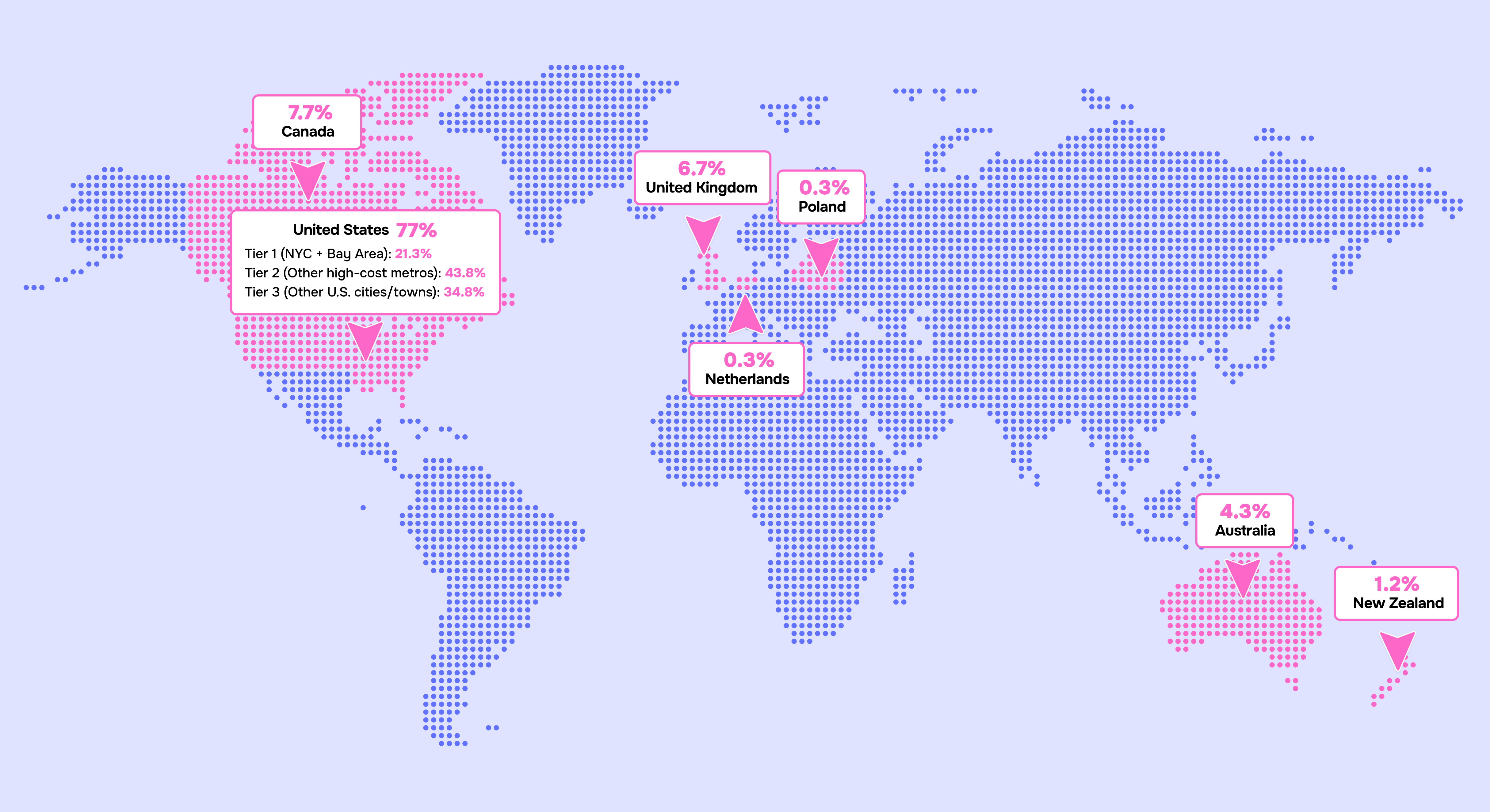
Most respondents are US-based, with meaningful representation in Canada, the UK, and Australia.
This map serves as a proxy on the maturity level of the EA profession in differing locations around the world.

Work arrangement

Number of executives supported

0
0.5%
1
41.7%
2-3
40%
4-5
12.1%
6+
5.7%
Over half of Executive Assistants support 2 or more executives.
The modern EA uses technology to balance priorities across multiple leaders.

Work location

21
%
Remote
44.3
%
Hybrid
34.7
%
In-office
Despite an overwhelming interest by Executive Assistants in remote roles, they’re still the minority though significant nonetheless.

Annual income

<$50k:
8.2%
$50k-$74k:
25.1%
$75k-$99k:
30.4%
$100k-$124k:
19.2%
$125k-$149k:
8.7%
$150k-$174k:
3.8%
$175k-$199k:
2.8%
$200k+:
1.7%

Pay by industry (in USD)

Slide to explore the list
<$50k
$50k–$74k
$75k–$99k
$100k–$124k
$125k–$149k
$150k–$174k
$175k–$199k
$200k+
Corporate and Large Enterprise
11.3%
23.9%
33.8%
19.7%
5.6%
2.8%
2.8%
Education
13.0%
31.9%
37.7%
14.5%
2.9%
Finance
25.9%
20.0%
23.5%
12.9%
5.9%
5.9%
5.9%
Healthcare
14.3%
22.4%
36.7%
12.2%
10.2%
2.0%
2.0%
Law
33.3%
41.7%
25.0%
Media and Entertainment
9.5%
19.0%
42.9%
23.8%
4.8%
Non-profit
15.6%
39.0%
31.2%
6.5%
6.5%
1.3%
Retail and Consumer Goods
16.7%
54.2%
20.8%
4.2%
4.2%
Small Medium Businesses
5.9%
37.3%
23.5%
19.6%
5.9%
7.8%
Startup
5.7%
15.1%
26.4%
22.6%
11.3%
13.2%
5.7%
Technology
1.6%
12.7%
24.6%
25.4%
15.9%
8.7%
7.1%
4.0%
Only Executive Assistants in Technology and Finance seem to break the $200k USD barrier. While not surprising that Non-profit roles are on the lower end of compensation, EAs in Law seem to have the lowest pay by far (though this could be due to a smaller Law sample size).

Pay by city

Slide to explore the list
<$50
$50k–$74kk
$75k–$99k
$100k–$124k
$125k–$149k
$150k–$174k
$175k–$199k
$200k+
Tier 1 (US: NYC & Bay Area)
1.8%
3.5%
12.3%
19.3%
29.8%
12.3%
10.5%
10.5%
Tier 2 (US: other high-cost metros)
2.7%
8.2%
32.9%
34.2%
11.0%
5.5%
2.7%
2.7%
Tier 3 (US: rest)
2.1%
29.6%
35.2%
20.2%
7.3%
3.1%
2.1%
0.3%
Non‑US (separate bucket)
24.8%
32.3%
27.8%
11.3%
1.5%
1.5%
0.8%
Unsurprisingly, roles with higher compensation are concentrated in high-cost of living areas.

Given industry, do you feel fairly compensated?

Industry
Yes
No
Finance
61.3%
38.8%
Startup
55.4%
44.6%
Small Medium Businesses
54.9%
45.1%
Technology
50.4%
49.6%
Healthcare
49.0%
51.0%
Retail and Consumer Goods
48.0%
52.0%
Education
46.2%
53.8%
Corporate and Large Enterprise
45.1%
54.9%
Non-profit
41.7%
58.3%
Law
16.7%
83.3%
Media and Entertainment
9.1%
90.9%
EAs working in Law and Media and Entertainment feel least fairly compensated, while those in Finance feel most fairly compensated.
Read the full 30-page report for 15 more data points on work arrangement such as “Pay by tenure” and “How is your role perceived within your organization?”.

Technology

Which of the following activities do you spend the most time?

Scheduling & calendar management

29.3%

Email & communication management

21.5%

Projects/strategic work

16.3%

Travel booking

13.5%

Event/meeting prep

7.2%

Other

12.2%

Nearly 30% had listed "Scheduling and calendar management" as the single activity they spent the most time on.

What is your primary calendar tool?

67.6%
28.2%
3.5%
0.7%
83% of top EAs spend significant time scheduling, yet most still use tools that were originally designed for email (Outlook) or personal use (Google Calendar) email, though a growing number are adopting tools dedicated to the Executive Assistant workflow (Vimcal EA).

Do you feel AI tools will replace, enhance, or have no major effect on EA roles in the next 5 years?

21
%

Replace

"I think there will be people that lose jobs, but for the people that are able to keep their jobs; it will enhance capabilities"
81.5
%

Enhance

"amplify like a brain exoskeleton for sure!"
4.7
%

No major effect

"I think some basic admin work can maybe be replaced but really EAs are doing so much more"
6.5
%

Not sure

"from what I am beginning to play with it can enhance but I don't trust, I feel like it's learning to take over like an Alien!"
85 % of respondents believe AI will enhance their role, not replace it. Only 3% foresee full automation. For EAs, AI is becoming the ultimate time-saver by summarizing meetings, drafting messages, and taking over otherwise menial tasks.

Which AI tools do you currently use for work?

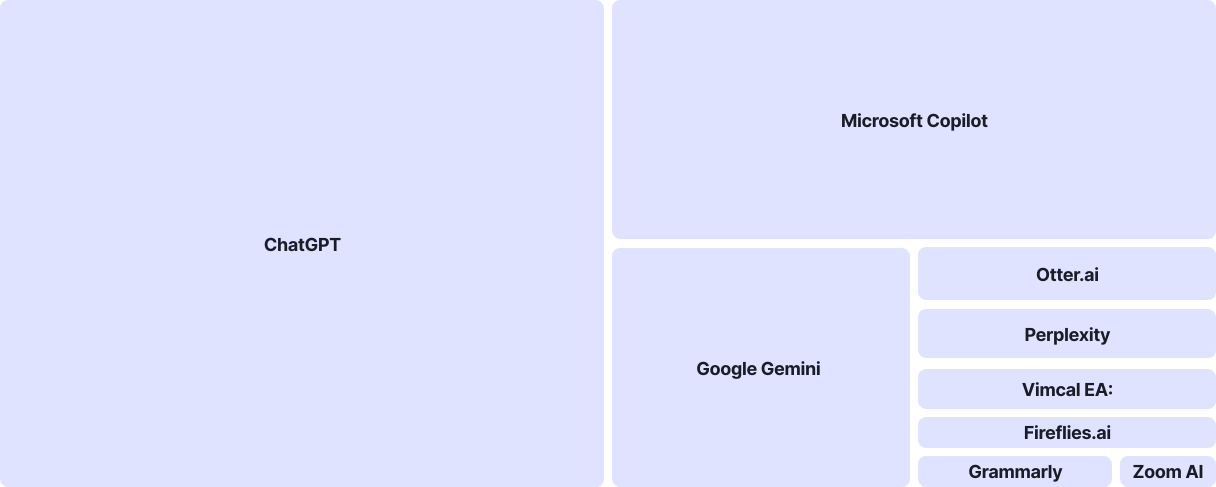
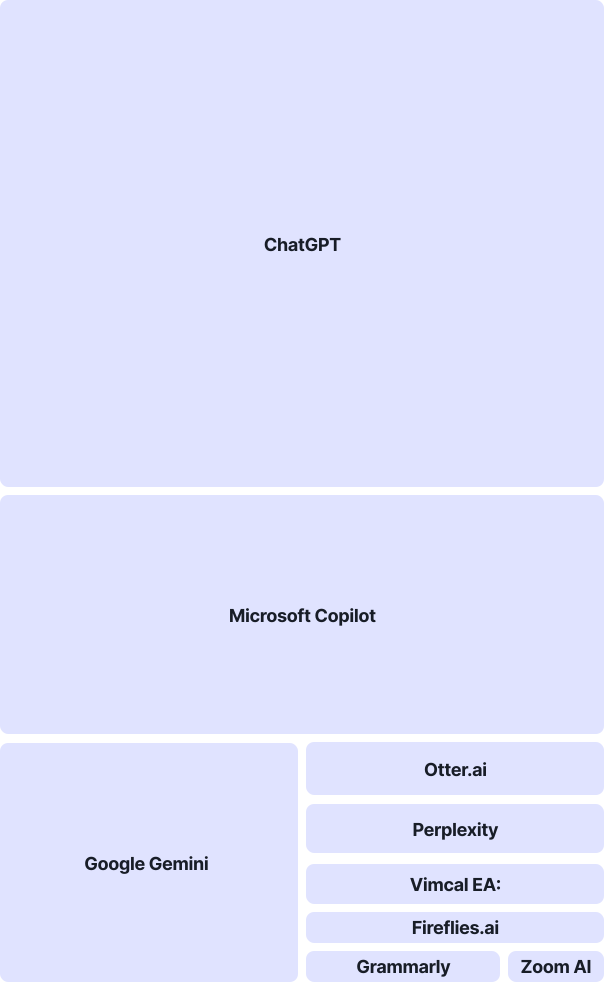
Based on a survey of 600 participants, #1 tool ChatGPT had 422 responses. 70 % of EAs use ChatGPT, 43 % use Microsoft Copilot, 20 % Google Gemini, 8 % Claude, and 8 % Otter.ai. Assistants are quickly mastering generative AI using it to draft agendas, polish communications, and plan smarter.
Read the full 30-page report for 8 more technology-related data points such as “Are you a gamer?“ and “What’s your go-to tool for each of these tasks: Video conferencing, Travel booking, Team communication, To-do/task tracking, Knowledge management”.

Short answers

Which soft skill has been most critical to your success as an EA?

“Anticipating Needs: By anticipating needs, I can be proactive and help prevent last-minute emergencies which allows both my executive and me to focus our time and energy on the more strategic initiatives.”
- Michael J, Executive Assistant
“Emotional intelligence, or EQ! The ability to understand and manage your own emotions, as well as recognize and influence the emotions of those around you.”
- Tricia Zarevich, Executive Assistant to the Superintendent and Board of Trustees
“Reading the room”
- Renee Verhaegen, Executive Assistant to the CEO and Alysa C., Executive Assistant and Ruth Snodgrass and Naila, Lead Executive Assistant
When asked which soft skill matters most, EAs overwhelmingly cited reading people’s body language, tone, and unspoken cues. Empathy and perception remain the ultimate edge in an AI-driven workplace.

What’s your proudest moment in your EA career?

“Organising a visit by Her Majesty Queen Elizabeth II to open one of our buildings”
- anon
“Getting a private PE person to respond to me within the same day. They don't have a digital footprint, so I wasn't able to reach out directly. I found ONE journal article about the person, and reached out to the journalist. They couldn't provide the contact info, but reached out to the person on my behalf. I got the call that same day :)”
- Jen A., Executive Assistant
“Watching my team on stage at our annual investment conference”
- Emily L, Senior Executive Assistant
From coordinating royal visits to managing product launches, EAs make the impossible happen quietly every day. Their proudest moments reveal why the profession endures: it’s built on precision, trust, and grace under pressure.
Read the full 30-page report for 12 more short answers to topics such as “What’s one thing you wish more EAs talked about openly?” and “What's one thing that you wish your boss would give up managing and let you take over instead?”.

Methodology

Data from 600 respondents, collected between Aug 14–31, 2025. Respondents were primarily CCing My EA readers and Vimcal EA users. Results were self-reported; percentages rounded to the nearest tenth.
Read the full 30-page  Executive Assistant Report (Free PDF)
Unlock 70% more data points, short answer stories, and advanced breakdowns.
By clicking “Accept All Cookies”, you agree to the storing of cookies on your device to enhance site navigation, analyze site usage, and assist in our marketing efforts. View our Privacy Policy for more information.